Before the Massachusetts Cash WinFall drawing on August 16, 2010, the state's published forecast gave other large betting groups little reason to play. A special payout wasn't expected.
James Harvey's group bought enough tickets to make it happen.
The purchases pushed the jackpot to a threshold that changed the payouts. Harvey's group had forced a favorable drawing while much of its competition stayed away. The inspector general reconstructed the surprise roll-down.
To understand why anyone would want to buy that many tickets, start five years earlier, in an MIT dorm.
Cash WinFall payouts
A ticket could be worth more than its price
In early 2005, Harvey was looking into lottery games as a possible independent-study project. Cash WinFall had an unusual rule. Players paid $2 to choose six numbers from 1 to 46. Matching all six won the jackpot, but there were smaller prizes for matching fewer numbers.
Normally, four matches paid $150. The chance of four matches was about one in 800. That prize contributed only about nineteen cents to a ticket's average return.
The calculation is prize divided by the number of equally likely opportunities needed, on average, to win it: $150 divided by roughly 800. Adding the corresponding contributions from the other prize tiers gives the ticket's expected value.
Harvey noticed that the calculation changed dramatically during a roll-down. When the jackpot reached $2 million and nobody matched all six, jackpot money increased the smaller prizes.
His first group bought 500 tickets for the February 7, 2005 drawing. One matched four numbers and paid $2,364. Together with other wins, the group's $1,000 purchase returned about $3,000. The MIT newspaper reproduced the investigation's account of Harvey's first pool.
At a payout of $2,364, a roughly one-in-800 event contributes about $2.95 to an average-return calculation. The four-match prize alone had become large enough to make a $2 purchase look attractive. The actual prizes depended on the drawing's pools and winners, so Harvey had to estimate them before buying. Mathematician Jordan Ellenberg examines the changing prize distribution.
Where does one in 800 come from?
There are 9,366,819 different six-number selections from forty-six numbers. The order doesn't matter: the same six numbers written in a different order remain the same entry.
For a particular draw, a ticket with exactly four matches contains four of the six winning numbers and two of the forty losing numbers. There are fifteen ways to choose those four winners and 780 ways to choose the two losers. Multiply them and there are 11,700 four-match tickets among the 9,366,819 possible selections.
That is about one in 800.6.
Buying more tickets gives more opportunities to collect those smaller prizes. It also costs more. The attraction was a payout distribution under which the expected winnings could exceed the purchase price.
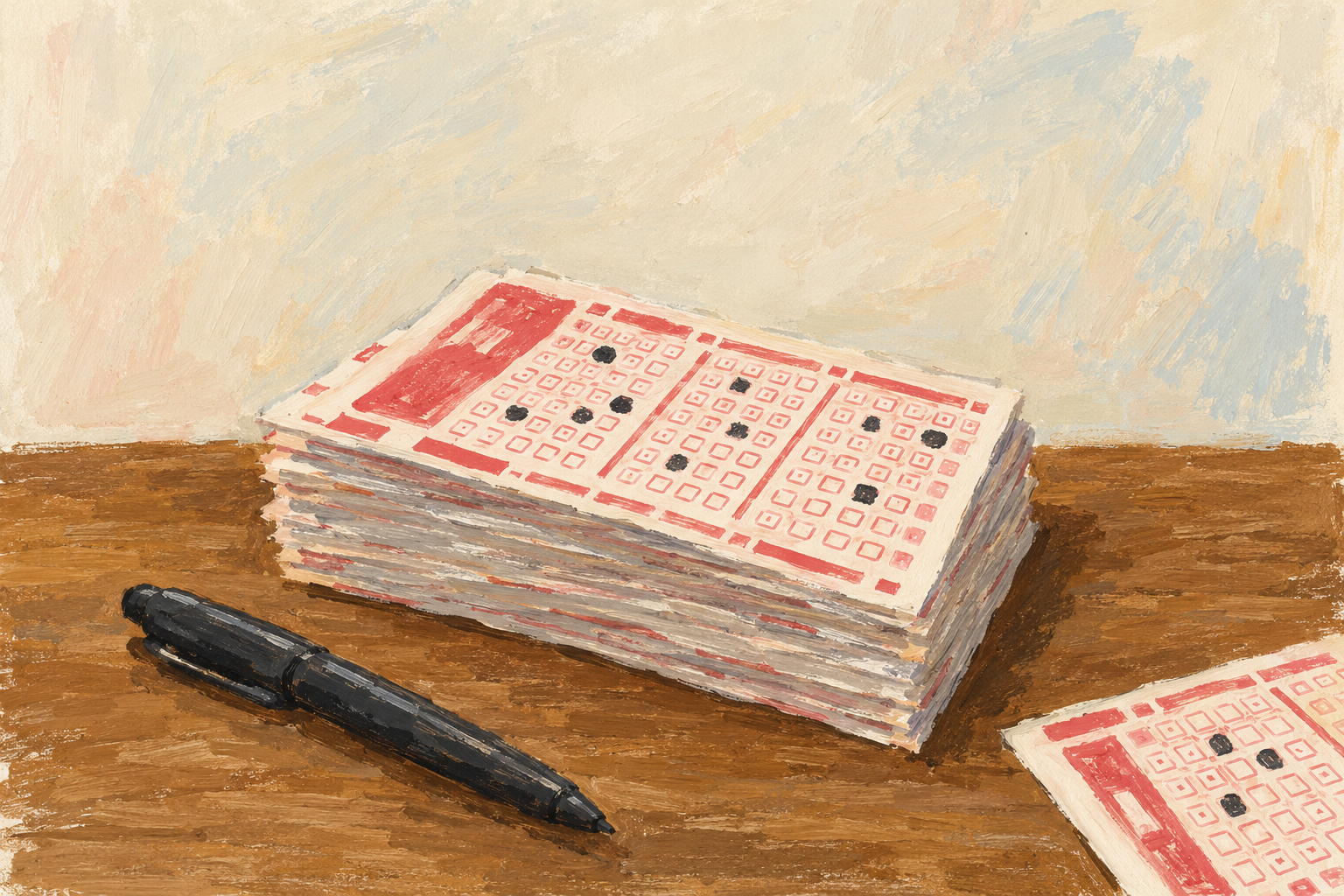
Harvey's group grew and developed a system for spreading selections across possible results. But buying the entries remained stubbornly physical. The rules required hand-marked betting slips. Machines had to read them and print valid tickets before the drawing. The regulations specify that process.
Filling slips, finding retailers, printing tickets, and sorting winners became part of the business. Enough money to place a bet didn't guarantee enough time to get it accepted.
Other people could do the calculation
Other groups also played Cash WinFall in volume. Their arrival changed Harvey's problem.
During a roll-down, parts of the available money were shared among winning tickets. More competing winners meant a smaller payment per winner. For the same shared pool, doubling the number of winning tickets halves each ticket's share.
Competition also increased the chance that someone would match all six and take the jackpot, preventing the anticipated roll-down. A large syndicate could spend heavily and receive much less than it expected.
The August 2010 opportunity combined the payout rule with a forecasting weakness. The state estimated future jackpots from expected ticket sales. The MIT group looked for a jackpot high enough that its own purchases could push it across $2 million, but low enough that the published estimate wouldn't attract rival syndicates. Ellenberg follows the calculation behind that decision.
Their wager became part of what they were calculating. Buying tickets added money to the game and helped determine which payout rule would apply. Once that happened, the group could collect a large share of the enhanced smaller prizes without its usual competitors making comparable purchases.
A later investigation found no evidence that lottery officials had colluded in the surprise. Internal communication had failed to keep the public forecast aligned with the extraordinary sales. The lottery subsequently changed its monitoring so unusual buying could trigger an updated announcement.
Harvey's group had begun by asking what a ticket was worth under the rules. In August 2010, it acted on a second question: how much would it cost to make those rules switch before everyone else noticed?