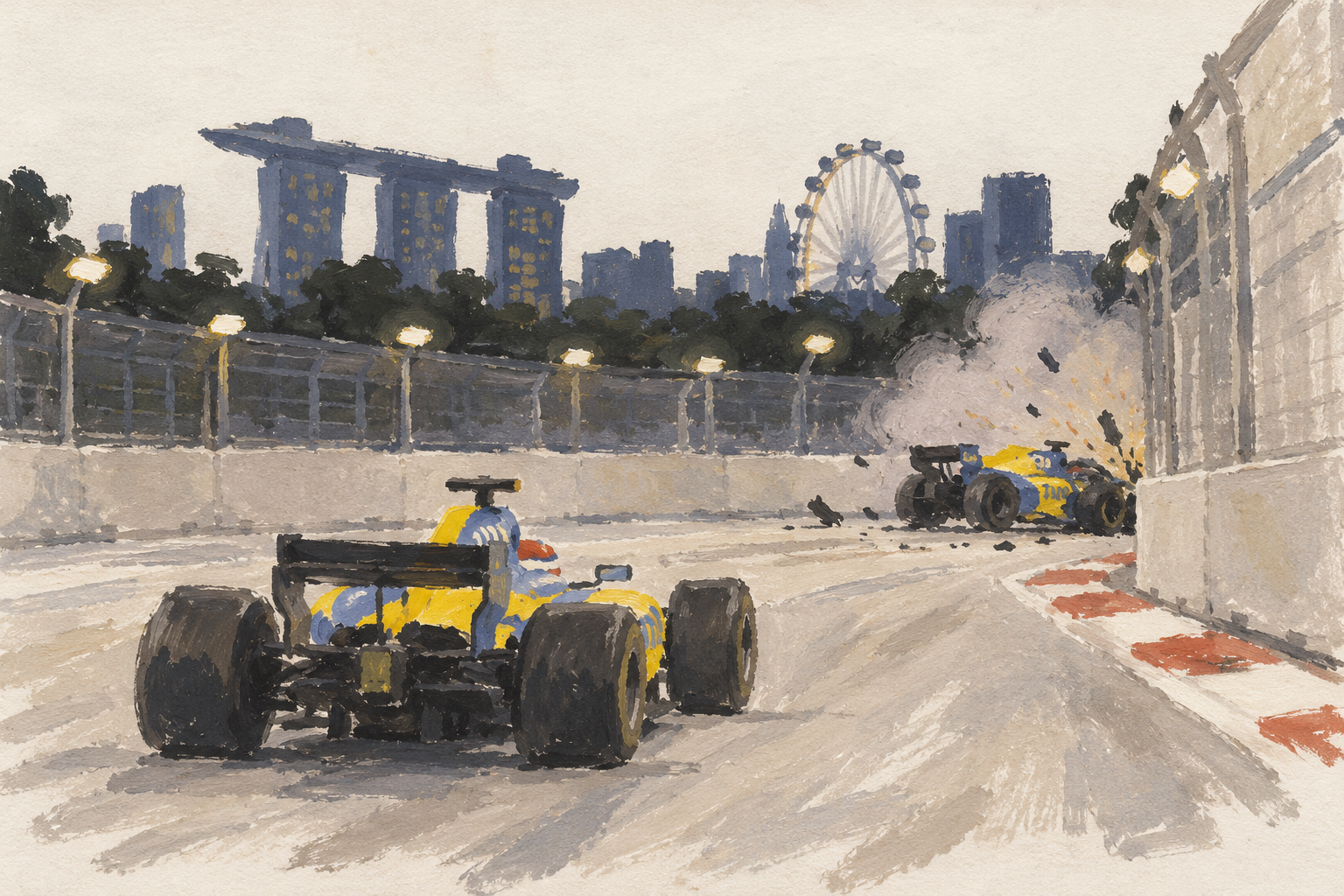
On lap twelve of the 2008 Singapore Grand Prix, Fernando Alonso entered the pits. His Renault received fuel and new tyres. He rejoined the race in last place.
Two laps later, his teammate crashed.
Nelson Piquet Jr hit the wall at Turn 17, scattering debris across the track. Race control sent out the safety car. Alonso would go on to win, having started fifteenth on a circuit where passing was difficult. The FIA's later investigation set out the sequence.
The result looked like an extraordinary recovery. The timing of the crash had helped create it.
Last place was temporarily cheap
Alonso had begun with a light fuel load, so his early stop was necessary. Carrying less fuel made the car lighter during the first part of the race, but entering the pits cost track position while everyone else continued racing.
After the crash, the safety car slowed the field and gathered it into a queue. The seconds separating the cars shrank. Alonso could catch the queue with his stop already completed.
Other drivers still needed fuel. The regulations made that an immediate problem: once the safety car was deployed, cars were prohibited from entering the pits to refuel until the field had formed up and the pit lane was declared open. Refuelling before that announcement carried a penalty. The 2008 sporting regulations specify the restriction.
Some drivers couldn't wait. Nico Rosberg, for example, needed to stop and incurred a penalty. Others waited for the opening and made their stops afterward. Alonso moved up as those cars left the queue.
The order of operations mattered. Alonso had stopped, lost time, then had much of the resulting gap compressed. A rival who joined the compressed field and then stopped gave away time that the first compression had already finished erasing.
Both drivers could perform the same two actions—stop and join the queue—and end up in different situations because the actions happened in a different order.
Singapore pit-stop sequence
Track position alone also concealed work still owed. A car ahead of Alonso might still need a long refuelling stop or have a penalty to serve. When the field reshuffled, the places on the road didn't tell the whole story of who was best positioned for the remaining race.
There was further chaos. Felipe Massa's Ferrari was released from its stop with the fuel hose still attached, ruining the leader's race. Alonso still had to drive the remaining laps successfully. But the interruption had removed a large part of the disadvantage created by his early stop. Formula 1's race history follows the pit-lane disruption.
Someone knew when the queue would form
Afterward, Alonso described the race as fortunate. In the post-race press conference, he explained that the first safety car had helped him enormously. The aggressive opening strategy had been chosen because his qualifying position left few attractive alternatives. The contemporary press-conference transcript records his account.
Nearly a year later, Piquet told the FIA that the accident had been deliberate. His account described a pre-race discussion about crashing to help Alonso, followed by instructions about the location and timing. A crash at Turn 17 would leave the car difficult to recover quickly and make safety-car deployment likely.
Investigators examined telemetry as well as testimony. The data showed unusual throttle use as Piquet lost control. Renault eventually declined to contest the charge that the team had conspired to cause the crash. The FIA found no evidence that Alonso knew of or participated in the conspiracy.
The mechanism was already visible in the order of the events. The investigation supplied what the timing sheet couldn't: evidence that the interruption had been arranged.
Formula 1's official result still lists Alonso first, after sixty-one laps. The classification records the finish.
His teammate's contribution appears elsewhere in the race records, as a retirement. To understand how the two results fitted together, follow the pit stop, the crash, and the queue—in that order.