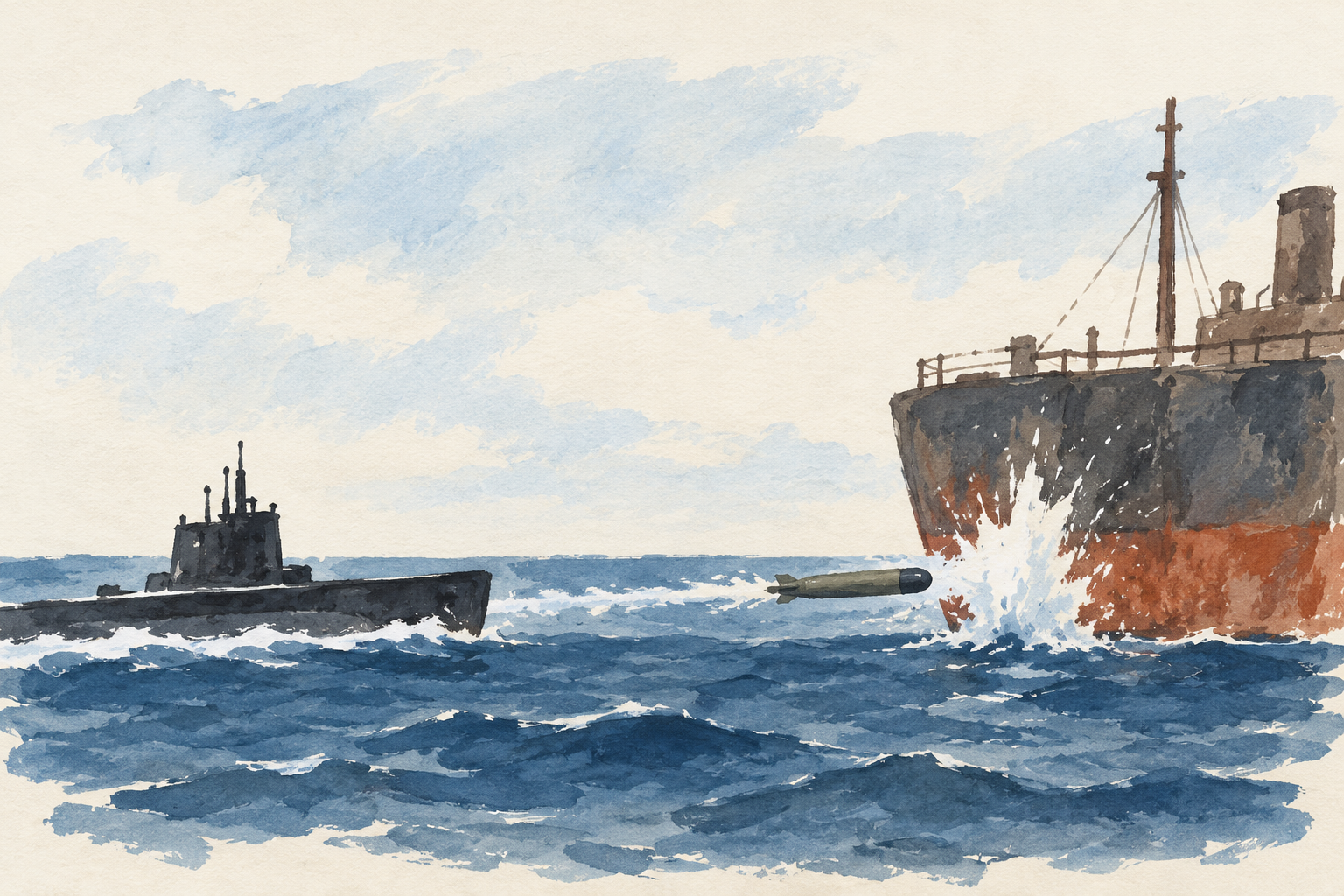
On July 24, 1943, Commander Dan Daspit had a Japanese tanker stopped in the water and an American submarine close enough to keep firing at it.
He watched torpedoes strike. They failed to explode.
The submarine was USS Tinosa. Its target, Tonan Maru No. 3, was a valuable tanker carrying fuel through the Pacific. Earlier hits had damaged it. Daspit maneuvered for further attacks, but the impacts that should have finished the job kept producing duds. He eventually returned to Pearl Harbor with evidence of a weapon that could reach its target and still fail. The Submarine Force museum's account follows his patrol report.
The Navy had spent months dealing with complaints about its Mark 14 torpedo. One fault concealed another. Torpedoes ran too deep. Their magnetic exploders could detonate prematurely. When the magnetic feature was disabled, failures in the contact exploder became harder to miss.
The torpedo’s contact mechanism
The tanker gave Daspit an unusually clear case. He had time to position the submarine, observe impacts, and repeat the attack. A captain could hardly be accused of missing a ship he'd watched his torpedoes hit.
What made a good hit bad?
A direct, square-on collision put the torpedo's forward motion into the impact. An angled collision allowed a different, less abrupt interaction with the hull.
The contact mechanism had to operate during that violent deceleration. Inside it, a moving component was supposed to travel into position and initiate the explosion. Under the loading of a direct hit, parts could bend or bind instead.
Testing exposed the reversal: an impact that looked ideal from the submarine could be particularly bad for the mechanism. Glancing or angled hits could work when direct hits failed. The Naval Undersea Museum describes the defective contact exploder and the tests.
The relevant relationship is how quickly motion changes. Losing a given amount of speed in half the time requires twice the average deceleration. The force on a component of the same mass rises accordingly. A small mechanism inside a rapidly stopping weapon has to survive that loading while still being free to move in the intended direction.
Collision angle affects which part of the torpedo's motion is driven straight into the target. At a square-on impact, essentially all its forward motion points into the surface. As the angle becomes more oblique, less of that motion is directed into the hull, and the interaction changes.
Two impacts at the same approach speed could therefore produce different loads inside the weapon. The most accurate attack could expose the weakness most severely.
The weapon had to function under the particular forces that a successful attack would create.
The target wasn't the problem
After Daspit's patrol, Rear Admiral Charles Lockwood ordered further tests. They included impacts against cliff faces and tests of the contact mechanism. The results confirmed that the firing equipment was defective. An interim response was to approach targets at more oblique angles while work on the equipment continued. The Naval History and Heritage Command recounts the investigation and operational response.
The eventual corrections included changes to the moving firing parts. A component's mass matters because the force associated with a given deceleration increases with that mass. Reducing it could help the mechanism survive the impact and complete its movement. The museum's history records the recommended mechanical changes and the weapon's improved performance by the fall of 1943.
None of that knowledge had been available to Daspit as he watched the tanker refuse to sink. He could improve the approach, shorten the range, and place another torpedo against the hull. Those were the things his submarine controlled.
Back in port, his attack could be read differently. The repeated failures were evidence of what happened after a successful hit. The torpedoes had reached the ship; the machinery inside them couldn't reliably survive arriving there.