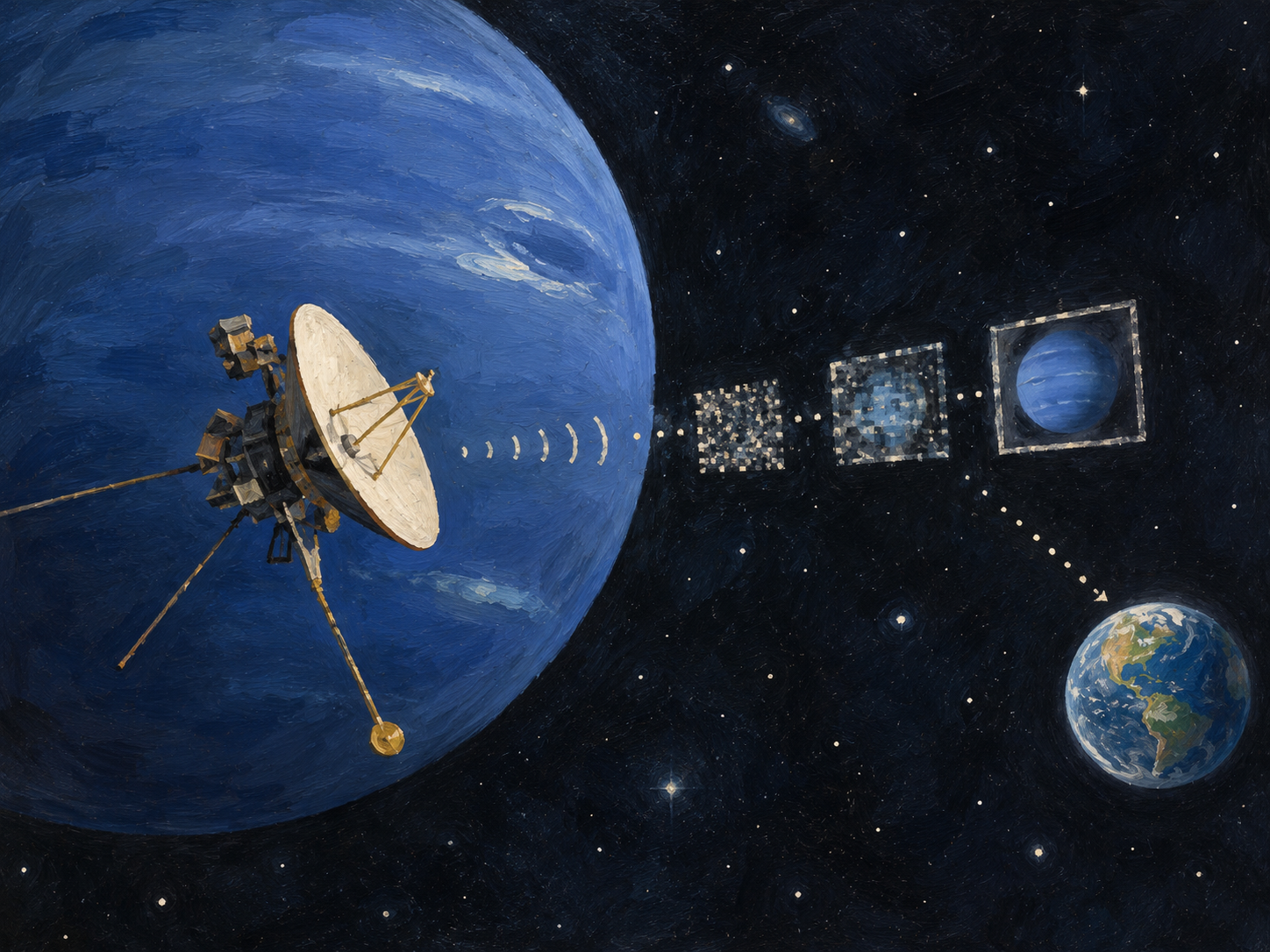
On August 25, 1989, Voyager 2 passed Neptune. The spacecraft had been traveling for twelve years. Back on Earth, engineers were preparing to recover its photographs from a radio signal arriving across billions of kilometres.
By then Voyager was roughly thirty times Earth's distance from the Sun away from the receiving equipment. The receivers needed to distinguish the faint transmission from noise and recover the numbers describing each image.
Engineers had prepared for this encounter years in advance. They enlarged receiving antennas, combined signals from multiple dishes, and used image compression aboard Voyager. They also sent extra information with each message so Earth could repair errors introduced along the way. JPL's communications history explains the encounter upgrades.
The radio link could carry only a limited amount of data. Engineers were spending part of that capacity on numbers that would help the rest survive.
A wrong number can still look normal
A digital image is a list of numbers. Voyager's camera images contained 800 rows of 800 pixels, with brightness values represented by eight bits each. A received bit changing from zero to one could change a pixel value without producing anything visibly impossible for the receiver to reject.
Repeating every message would provide a comparison, but two disagreeing copies don't identify which is correct. Three copies permit a majority vote, at the cost of tripling the transmission.
Error-correcting codes use redundancy more efficiently. They restrict which combinations can be sent. A damaged combination can then point back toward the valid one it came from.
Voyager carried a Reed–Solomon encoder. Its code grouped information into blocks and added mathematical relationships between the symbols. On Earth, decoding equipment could use those relationships to locate and correct errors. NASA's engineering reports describe the block code and its correction capability.
Here is a small version of the underlying idea. A straight line is fixed by two points. If five transmitted points are supposed to belong to one line and one arrives in the wrong place, the other four still identify the line. The inconsistent point can be corrected.
The message has gained protection because the points must obey a shared relationship. Five arbitrary points would offer no such clue.
Voyager error correction
223 data symbols + 32 check symbolsReed–Solomon coding extends that reasoning using polynomials, which can describe more complicated relationships. Its arithmetic operates in a finite collection of values, allowing every result to remain a valid digital symbol. The encoder builds a block with enough related values that a limited number of corrupted symbols can be reconstructed.
The Voyager system used blocks of 255 eight-bit symbols containing 223 information symbols. The remaining 32 supplied redundancy. That structure could correct up to sixteen erroneous symbols in a block. A symbol whose location is known to be missing costs less correction capacity than an error hidden among apparently normal values. A JPL decoder design explains the distinction between errors and erasures.
The receiving dishes had gaps of their own
For Neptune, NASA combined reception at Goldstone in California with the Very Large Array in New Mexico. The arrangement increased collecting power, but the VLA's operation introduced recurring gaps that the communications system had to accommodate.
A gap could damage a cluster of neighboring symbols. Engineers therefore interleaved codewords: symbols belonging to different blocks were mixed during transmission and reunited afterward. A short interruption was spread across several blocks instead of wiping out one concentrated piece.
That gave the decoder a more manageable problem. Each block could lose some symbols while retaining enough of its relationships to recover the message. A contemporary analysis examined whether the gaps and ordinary transmission errors would stay within the available correction capacity. The 1989 technical report follows that calculation.
Voyager's images also contained less unnecessary repetition by this stage of the mission. Compression reduced the bits needed to describe an image, while coding added the particular redundancy needed to survive transmission. Those operations served different purposes and worked together.
The Neptune flyby was a one-time opportunity. Voyager would continue outward; Earth couldn't ask it to repeat the encounter. Engineers had to make the data it collected count, including the parts that would arrive damaged.
The correction symbols took up space in the transmission. In return, they let a receiver recover picture data that noise had changed along the way. Voyager could keep sending useful photographs as the signal grew weaker.