When investigators searched the papers of a French telegraph operator named Pierre Guibout, they found evidence that didn't look much like a communications system: gloves, financial records, and notes linking telegraph signs to deliveries of clothing.
The gloves were carrying stock-market news.
An account of the investigation appeared in the Gazette des tribunaux in January 1837. It described packages arriving from Paris and payments that seemed difficult to explain on an operator's wages. The packages were part of a scheme that had been running since 1834. At the far end of it, the Blanc brothers were trading in Bordeaux with information their competitors hadn't received. The newspaper reproduced material from the indictment.
The brothers had found a way into the government's fastest communications network. They only needed it to make a few mistakes.
A message with two audiences
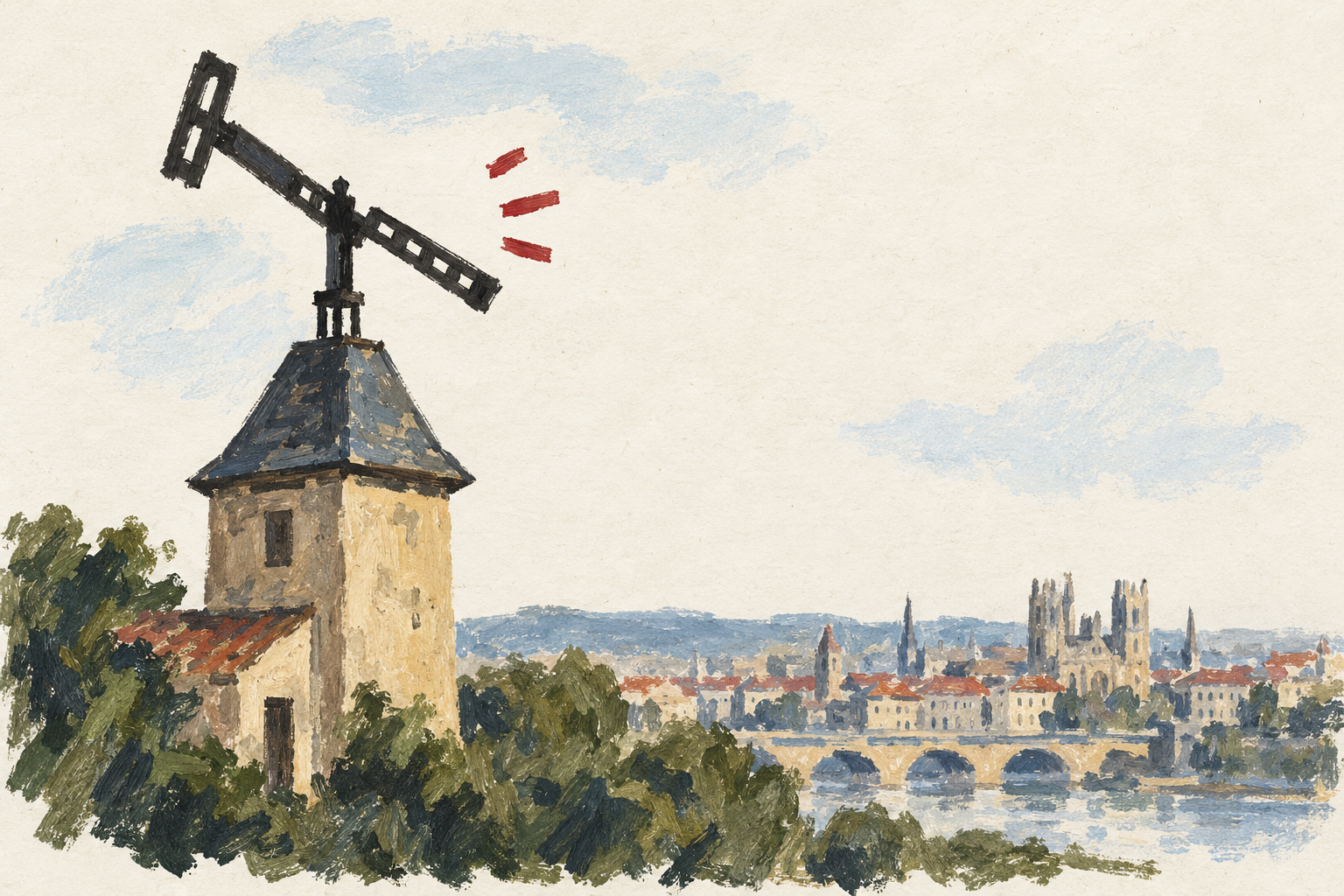
France's Chappe telegraph used towers with movable arms. An operator watched a neighboring tower through a telescope, copied its signal, and passed it along. A message could cross a large distance far faster than a horse could carry the same information.
Private traders couldn't simply walk into an office and buy the service the brothers wanted. But they could pay someone inside the network.
A contact in Paris followed the market and sent packages to Tours. Their contents conveyed whether the relevant price had moved upward or downward. Guibout could read that instruction without receiving an obvious written market report.
From Tours, he inserted an agreed signal into traffic heading toward Bordeaux, followed by a correction. The next operator copied what appeared on the neighboring tower. The mistaken sign traveled down the line, accompanied by the instruction that it should be disregarded.
At the destination, the official message was corrected. The brothers' observer had already seen the extra signal. A nineteenth-century history explains how the false sign survived transmission but disappeared from the completed dispatch.
An official reading the finished dispatch and an accomplice watching the tower were receiving different information from the same sequence.
The telegraph signal
How little did they need to know?
The brothers didn't need a complete account of the day's trading. A signal distinguishing a rise from a fall could tell them which direction to trade before Bordeaux caught up with Paris.
Those two possibilities fit into one binary choice: what we now call a bit. The expensive part was obtaining the information early. Once someone had observed the market, conveying that distinction required very little capacity.
That made the network's handling of corrections useful. Two sequences could leave the same official text behind: one with a deliberately chosen error, another without it. Anyone who examined only the corrected result would lose the distinction that mattered to the traders.
The receiving observer preserved that distinction. An error that the government considered disposable was a message to someone else.
This is a covert channel: information travels through a feature of a system that wasn't intended to carry that communication. Here, the extra capacity was in the sequence of signs used to correct a dispatch. The fraud depended on how operators handled those signs, all the way from insertion to final transcription.
It also explains the gloves. The operation had two successive channels. A package conveyed the market's direction from Paris to the bribed operator; an apparent correction then conveyed it rapidly from Tours to Bordeaux. Each participant needed the agreed interpretation at the right stage.
The system reached a courtroom
The scheme eventually came to the authorities' attention, and investigators reconstructed the relationships behind the signals. The prosecution concerned people, payments, packages, and the use of government equipment. Its physical evidence made the information route visible.
The brothers were acquitted in 1837. The law hadn't adequately covered their unauthorized use of the telegraph. Legislation establishing the government's monopoly on telegraphic transmission followed that year. The French cyber-history project traces the case and the legal response.
For the government, correcting a dispatch meant producing the intended text. For the brothers, the correction itself was something worth watching. By the time the official reader threw away the mistake, the stock tip had arrived.