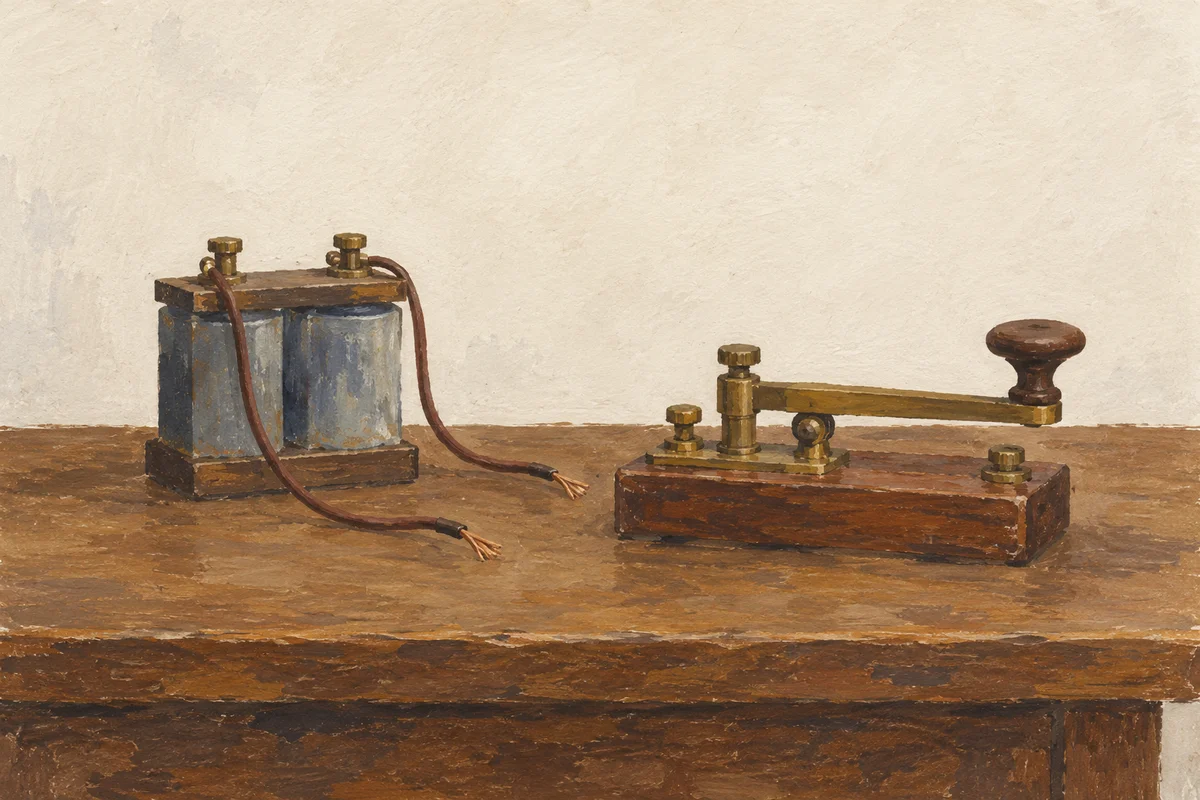
During the solar disturbances of 1859, telegraph operators between Boston and Portland disconnected their batteries. They kept sending messages.
Some of the time, the line worked better.
The equipment had acquired a power supply nobody had installed. A severe disturbance in Earth's magnetic environment created electric fields capable of driving current through long conducting systems. Telegraph wires were exceptionally well placed to collect that effect.
A normal telegraph circuit used a battery to drive current. The operator opened and closed the circuit with a key, turning the current into a message. An external voltage could add to the battery's push or oppose it. Either could interfere with the receiver.
For a moment, suppose a circuit has ten ohms of resistance and a ten-volt battery. Ohm's law gives a current of one ampere. Another five volts acting in the same direction raises the current to 1.5 amperes. Acting against the battery, it cuts the current to half an ampere.
The operator can control the battery and key. The extra contribution changes on its own. A pulse can become too strong, disappear, or arrive when no one has keyed it.
Disconnecting the battery removes one contribution. If the external field can still drive current through the connected line and ground path, the operator may be able to key that current instead. That's what makes the Boston–Portland report so revealing: the operators changed the circuit and communication continued.
Telegraph circuit
10 V + 5 V = 15 V. Dividing by 10 Ω gives 1.5 A.
Length helps explain why telegraphs were exposed. An electric field's effect accumulates along the route. In a uniform field aligned with a wire, ten kilometers collects ten times the voltage of one kilometer. Change the orientation and the contribution changes too. Real ground conditions and fluctuating fields make the calculation more complicated, but a long wire reaches across much more of the disturbance.
The network's greatest strength had created its vulnerability. Stretching a circuit across geography allowed almost instant communication between distant towns. It also put the circuit into an electrical environment far larger than the battery on an operator's desk.
Richard Carrington observed a bright solar event on September 1, during the wider sequence of disturbances. The telegraph reports preserved its consequences in the machinery people were already using. Operators described shocks, erratic instruments, and the peculiar success of sending a message after removing the expected source of power.
They could switch off their batteries. They couldn't switch off what was happening around Earth.
Sources and further reading
- 01Eyewitness Reports of the Great Auroral Storm of 1859
James L. Green and colleagues · NASA-hosted research, 2005
- 02Geomagnetically Induced Currents
U.S. Geological Survey
- 03