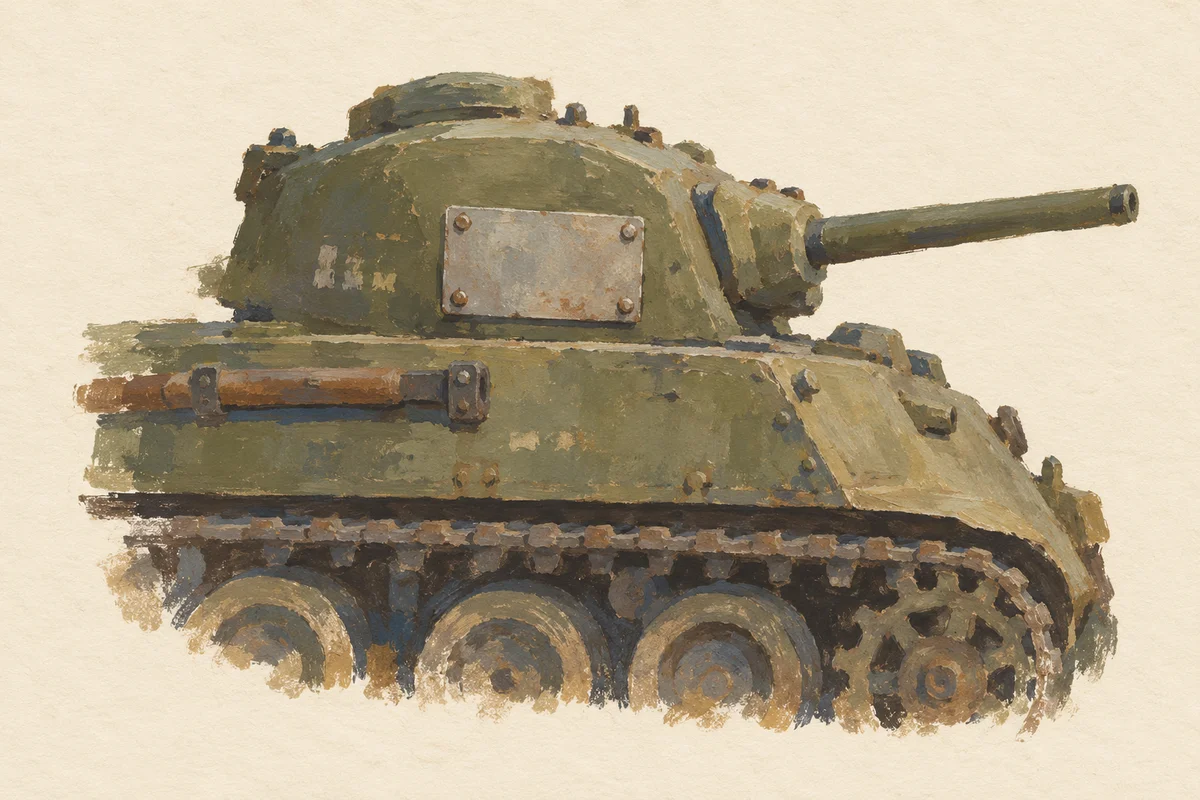
It's 1944, D-Day a few weeks out. You're an Allied intelligence officer in a windowless room in London, staring at a wall covered in photographs, intercepted messages, and hand-drawn maps. One question: How many tanks does Germany have?
Not an academic exercise. Underestimate, and thousands of soldiers hit the beaches of Normandy to face firepower they weren't prepared for. Overestimate, and you've wasted months on a threat that doesn't exist. Getting this wrong in either direction could lose the war.
So they sent in the spies. Agents across occupied Europe risked their lives for intel — intercepted communications, secret factory reports, informants deep inside the German war machine. After months of dangerous work, the answer came back: Germany was producing roughly 1,400 tanks per month.
Then a small group of statisticians said: actually, it's around 246.
Estimating production from serial numbers
No spies. No secret documents. Just a handful of busted gearboxes pulled from captured tanks.
The military brass probably laughed. 246 is barely a sixth of 1,400. Why would anyone trust a few math nerds over an entire intelligence network?
After the war, the Allies got Germany's actual production records from Albert Speer's ministry. Real number: 245 tanks per month.
The statisticians were off by one. The spies were off by over a thousand.
The trick is almost embarrassingly simple. Serial numbers.
German factories stamped sequential serial numbers onto every part of every tank — chassis, engine, wheels, and most importantly, the gearbox. Tank #1 got gearbox #1. Tank #2 got gearbox #2. You get it.
When Allied forces captured or destroyed German tanks in the field, they wrote down the serial numbers. A tank in North Africa: gearbox #45. Italy: #187. France: #224.
If the highest number you've seen is 224, Germany has built at least 224 tanks. Probably more — you're unlikely to have captured the very last one off the line. So: how many more?
The statisticians worked out that it depends on two things: the highest serial number in your sample (m) and the total number of tanks you've captured (k). Their formula:
N = m + (m/k) - 1
Say you capture 5 tanks with serial numbers 19, 40, 42, 51, and 60. Highest is 60, sample size is 5. Average gap between numbers: roughly 60/5, or 12. The formula says add one more average gap to your highest number — because if your sample is random, the real maximum is probably sitting about one gap beyond what you've already seen. So N = 60 + 12 - 1 = 71.
Statisticians call this a Minimum Variance Unbiased Estimator. Fancy way of saying: out of every formula you could write to estimate the total, this one lands closest to the truth most consistently. Not inflated, not conservative. Just accurate.
The spies had agents, double agents, codebreakers. They were off by more than a thousand. The statisticians had gearbox serial numbers. They were off by one.
It wasn't that the spies were incompetent. Human intelligence is genuinely messy. Informants exaggerate. Intercepted reports get planted. Captured officers lie. The Germans were actively spreading misinformation to make their forces look bigger — and all that noise pushed the estimate up to 1,400.
A serial number doesn't have an agenda. The formula doesn't care what you want the answer to be.
The same logic has turned up in strange places since then. In the 1980s, Americans with access to Israel's Merkava production line used serial numbers to estimate classified production rates. People have reconstructed total Commodore 64 manufacturing this way. In 2008, a London investor asked people online to post their iPhone serial numbers so he could estimate Apple's distribution volume.
Beyond serial numbers, the core idea applies anywhere you're trying to count something you can't fully see. Wildlife biologists do a version of this with tagging and recapture studies. Software teams estimate total bug counts by seeing how many independent testers stumble onto the same issues. It's a surprisingly general tool.
There's something that bothers me about the spy side of this story, and it's not that they were wrong. It's that their method felt like it should work. Espionage is dramatic and dangerous and complex. It produces specific details, names, dates, tonnage figures. A formula on a chalkboard produces a number with no story attached. Of course you trust the spies.
But the spies were asking what people could tell them. The statisticians were asking what the tanks themselves could tell them. Those are different questions — and only one of them has an answer that can't be faked.
This was Adam and Aidan, and thanks for reading another post of the Common Denominator.