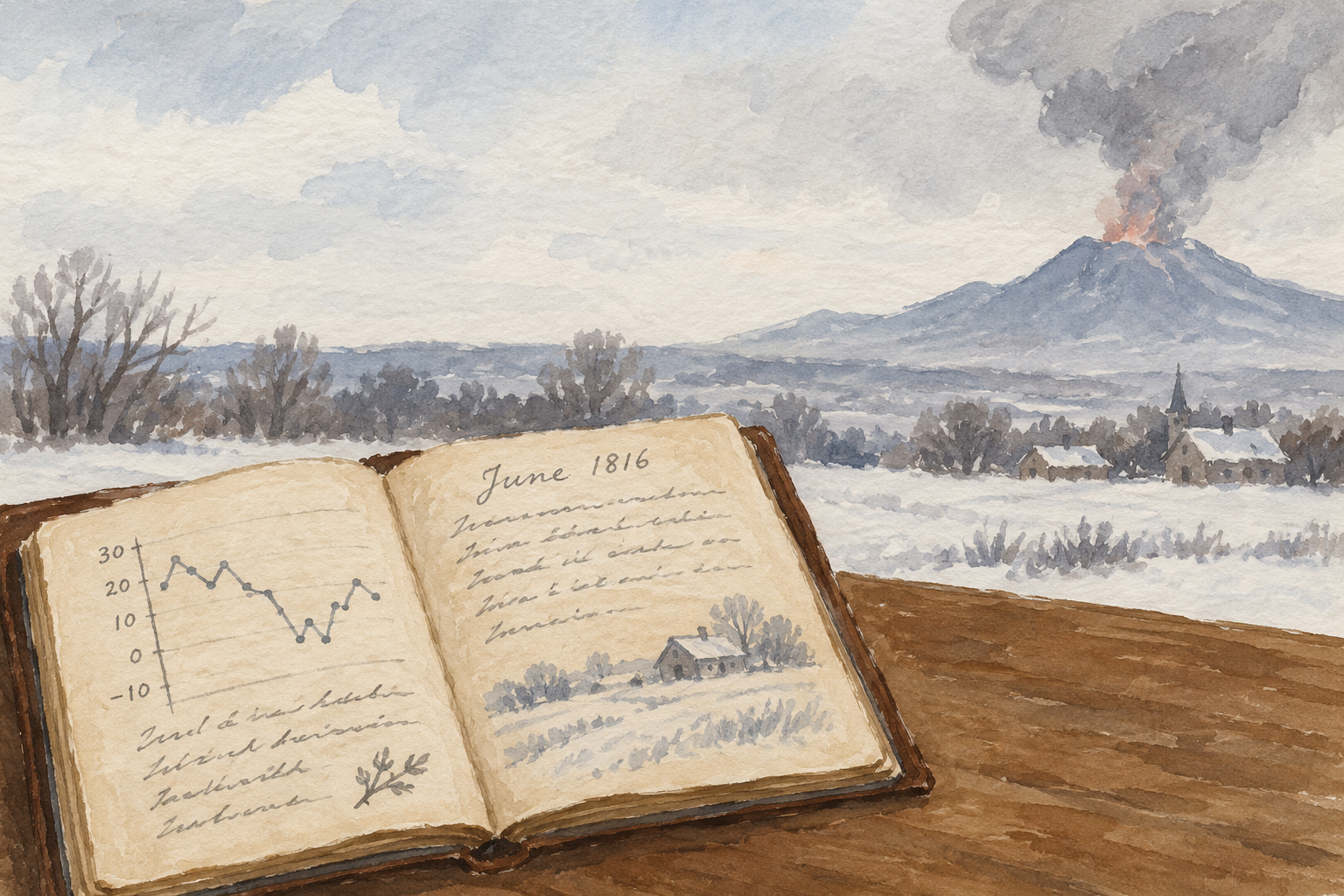
In June 1816, snow fell in parts of New England. Crops suffered through a growing season that seemed to have misplaced summer.
The previous year, Mount Tambora had erupted in Indonesia. Material injected high into the atmosphere reduced the sunlight reaching Earth's surface and contributed to widespread cooling. A volcano thousands of kilometers away could change the weather on a farm.
But how do you reconstruct that weather two centuries later?
People had left measurements. Thermometer readings survived in diaries, newspapers, observatory books, and ships' logs. In a 2015 study of 1815–17, Yuri Brugnara and colleagues assembled more than fifty sub-daily pressure and temperature series. The challenge began after finding the numbers.
A diary says the temperature was fourteen degrees. Is that cold?
For a place whose usual June temperature is eighteen, it's four degrees below normal. For a place usually at twelve, it's two above. Subtracting a local reference temperature gives an anomaly, allowing researchers to compare how unusual the weather was across different climates.
The clocks matter too. One observer's morning reading can't be compared directly with another's afternoon reading. Move a thermometer, change its exposure to sunlight, or switch the observation hour, and you can introduce a jump that looks like a change in the weather. Researchers need the notes about how the numbers were taken.
Even a well-reconstructed average leaves out something important to a farmer. Suppose ten nights average ten degrees. They could all stay near ten. Or one could fall below freezing while the others are warmer. The averages match; the damage to a frost-sensitive crop may be completely different.
Nightly temperatures
Ten-night exampleThat is why the timing of 1816's cold mattered. A frost during a vulnerable stage of growth could ruin crops even if the whole season's average seemed only moderately unusual. Rain and the ability to work the fields affected harvests too.
Putting the old observations together lets researchers investigate those sequences, rather than flattening the year into one temperature. It also leaves room for regional differences: Tambora's effects did not give every place identical weather.
The famous June snow is easy to picture. Recovering the season around it required much quieter evidence: a measurement, a place, an hour, and someone who had bothered to write them down.
Sources and further reading
- 01A collection of sub-daily pressure and temperature observations for the early instrumental period
Y. Brugnara and colleagues · Climate of the Past, 2015
- 021816: The Year Without Summer
National Park Service