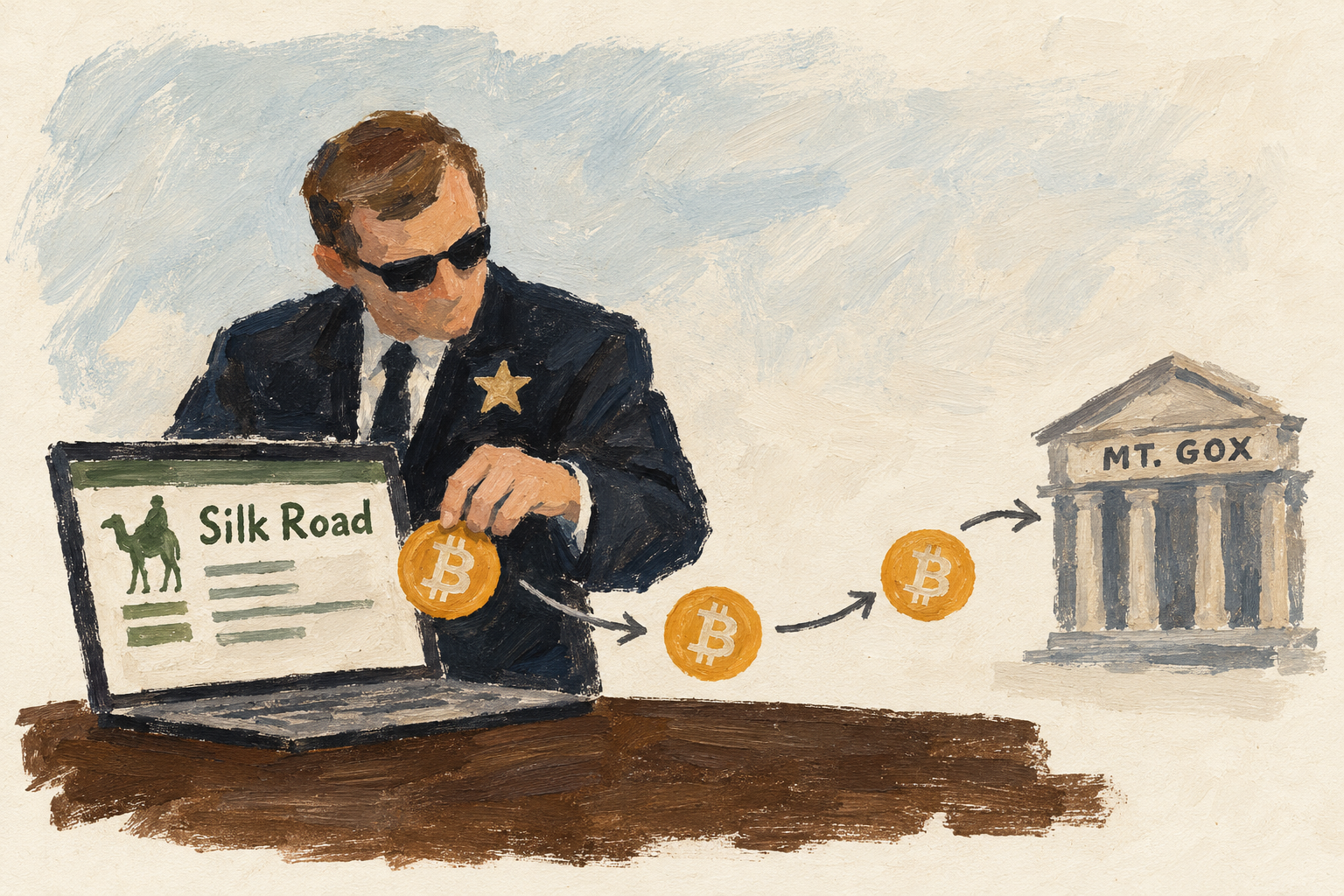
In May 2013, Secret Service agent Shaun Bridges helped the government seize money from the Bitcoin exchange Mt. Gox. He had also been receiving money from it.
His final wire transfer had arrived two days earlier.
The money went into an investment account belonging to a company he had recently established. According to the criminal complaint, the transfers from Mt. Gox totalled more than $800,000. Bridges was supposed to be investigating the illegal marketplace Silk Road. He had found a way to make the investigation pay. Federal criminal complaint
Silk Road sold drugs over the internet. Buyers and sellers used aliases, reached the site through the Tor network, and paid in bitcoin. Ross Ulbricht, its operator, ran it under the name Dread Pirate Roberts. Federal investigators were trying to get close enough to establish who that person was.
Tracing a Bitcoin transfer
One opening came in January 2013, when agents arrested Curtis Green, a member of the site's support staff. Green could help investigators enter the marketplace under an identity its users already trusted. His account also gave them access to administrative tools.
Bridges used that access to change users' passwords and empty their bitcoin accounts. Roughly 20,000 bitcoins disappeared, worth about $350,000 at the time. The theft appeared to implicate Green, whose account Bridges had used. Ulbricht believed Green had betrayed him and sought to have him killed. The appeals court's account of the investigation
The stolen coins eventually reached Mt. Gox, where Bridges sold them. Dollars then travelled through the banking system into his company's account.
Moving the money through Bitcoin had left investigators something useful: a public record of the movements.
The transfers kept their history
A Bitcoin address doesn't come with a person's name attached. Looking at one on its own tells you very little about who controls it. But spending bitcoin creates a transaction that points back to the earlier payments being spent.
That link is essential to making the currency work. Without it, someone could claim the same money repeatedly. The network needs to check that a payment spends funds that exist and haven't already been spent elsewhere.
The transaction also has to account for the value it receives. Its outputs, plus its fee, use up its inputs. A payment can divide value among several destinations, and a later payment can bring value from several earlier ones together. Those divisions and combinations remain visible in the transaction record. Bitcoin's original design
Draw each transaction as a point and each payment into another transaction as a connecting line. What looks like a collection of meaningless addresses becomes a graph: a set of things joined by relationships.
An investigator can follow those relationships without knowing every person's identity. The difficult step is attaching a real person to the relevant part of the graph.
An exchange can provide that attachment. Its internal records can connect a deposit to a customer account, a sale, and a withdrawal into a bank. The public ledger supplies continuity between transactions; the exchange and bank supply records about the people using them. Changing the form of the money doesn't automatically break that chain of evidence.
In Bridges' case, investigators could compare the cryptocurrency movements with the Mt. Gox transfers and his financial records. An IRS investigator later identified the Bridges investigation as an early case in which blockchain tracing and the grouping of related addresses helped produce a conviction and recover stolen funds. Investigator's sworn account
Bridges pleaded guilty to money laundering and obstruction of justice. In December 2015, he received a 71-month prison sentence. Sentencing announcement
There was a further theft.
Before Bridges reported to prison, investigators arrested him again. He had used a private key to take approximately 1,600 bitcoins from a government-controlled wallet, transferring them into accounts he controlled at other exchanges. In November 2017, he received another two years, to be served after his original sentence. Second sentencing announcement
By then, the government had seized bitcoin from criminals and put it in its own custody. Bridges still had a key that could authorise a transfer. The ledger accepted the transaction and recorded it, just as it had recorded the theft from Silk Road.