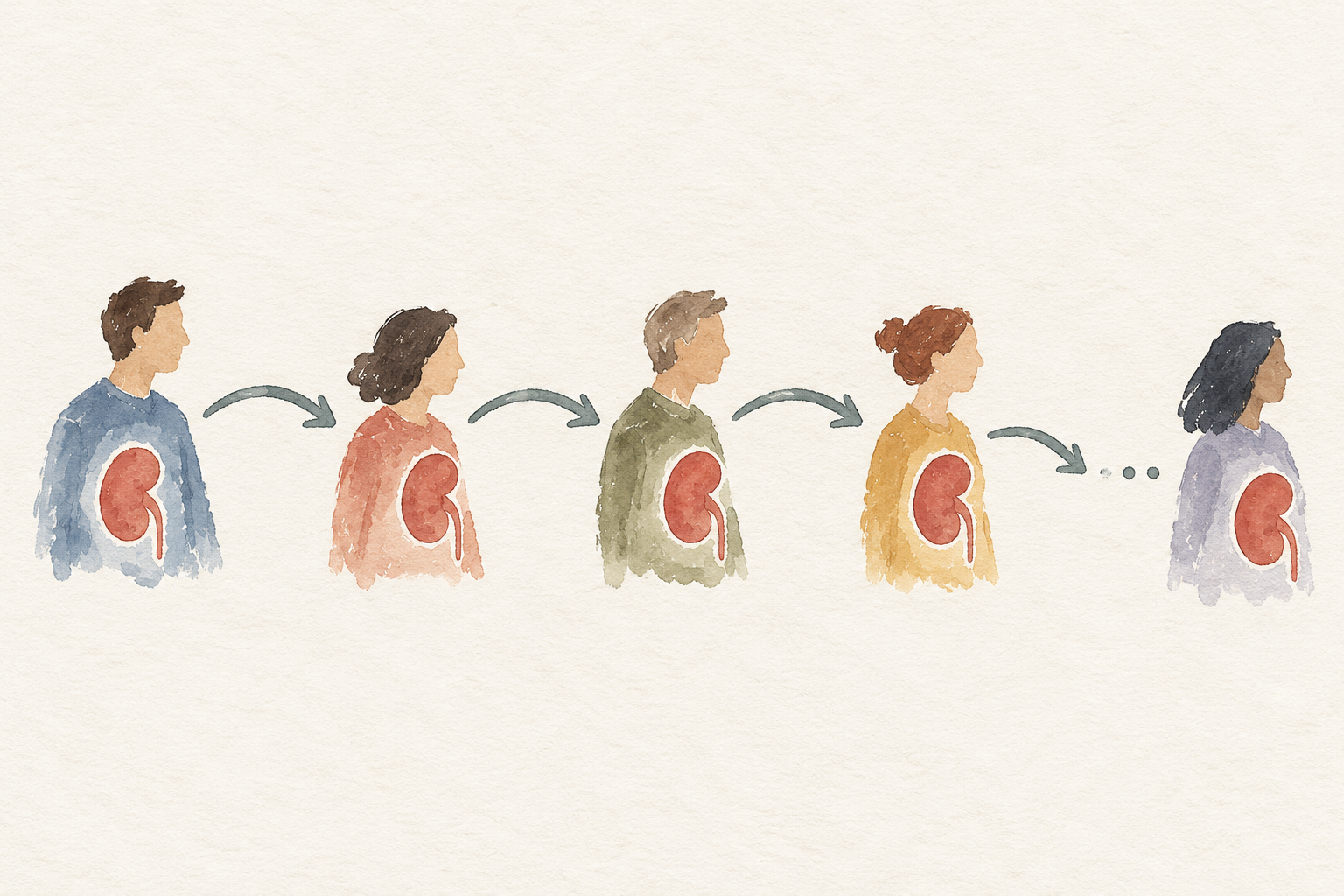
On July 18, 2007, a twenty-eight-year-old man from Michigan donated a kidney in Phoenix, Arizona. The recipient was a fifty-three-year-old woman whose husband wanted to donate to her but couldn't: medical testing had shown that they were incompatible.
Eight days later, her husband traveled to Toledo, Ohio, and donated a kidney to another woman. Her mother wanted to donate too, but couldn't give to her own daughter. She would become the next donor in the sequence. The medical team's report documents the first operations.
The Michigan man had offered one kidney. Doctors and a matching system were using that offer to unlock donations from people who had already volunteered to help someone else.
A willing donor can be the wrong donor
A person who needs a kidney may have a healthy friend or relative willing to give one. Blood type and other immune-system incompatibilities can still prevent the transplant.
Two incompatible pairs sometimes solve that problem by exchanging donors. Each donor gives to the other pair's patient. Both patients receive a compatible kidney.
But a useful exchange might require three pairs, or four. Someone else's donor may be compatible with a patient even when that patient's donor cannot return the favor directly. The connections have to be followed farther before a complete exchange appears.
Computer scientists Tuomas Sandholm, Avrim Blum, and David Abraham developed algorithms to search these possibilities. The system used for the 2007 chain could find larger exchanges and sequences begun by donors who had no intended recipient of their own. Carnegie Mellon describes the algorithm's contribution.
The mathematical representation is a directed graph. Each point stands for a patient and that patient's willing donor. An arrow from one point to another means the first pair's donor could give to the second pair's patient.
An arrow doesn't necessarily work in reverse. The direction records an actual compatibility relationship. Following several arrows can reveal an exchange that would be invisible if each family searched only for its own direct swap.
The algorithm also has to choose among competing possibilities. A donor who can help several patients can give only once. Committing that donor to one match may remove a longer sequence elsewhere. Finding many possible matches and choosing a workable collection are separate problems. Sandholm explains the computational task in this research presentation.
Why a stranger changed the shape of the problem
In a closed exchange, each family expects a kidney in return for its donation. That creates a dangerous timing problem. If one donor gives first and the corresponding return donation later fails, a family can lose its donor without receiving the promised transplant. Simultaneous operations help protect against that outcome, but arranging more operating rooms and medical teams makes large exchanges harder.
An altruistic donor can begin a chain without waiting for a kidney in return.
The first patient receives a transplant. That patient's willing donor can then donate onward. The next family receives before its donor continues the chain. An interruption still disappoints people and wastes opportunities, but a waiting family hasn't already given away its own donor's kidney.
Kidney exchange
This changes which sequences are feasible. The chain can pause between operations and resume when a suitable match appears. Research on kidney exchange examines why these longer chains can reach patients that short closed exchanges leave unmatched. Roth and his collaborators analyze the value of long chains.
The 2007 sequence did pause. A later donor was difficult to match within the participating registry. The organizers widened their search to another program. Across eight months, the chain reached ten recipients at six transplant centers in five states. Some operations were simultaneous; others were separated by months. The original report's abstract summarizes the completed sequence.
The sequence depended on people continuing to volunteer after their own loved ones had received transplants. The arrows on the diagram remained promises until someone arrived at a hospital and followed through.
Back in Phoenix, the first woman's husband had been unable to give her the kidney she needed. Once she received one from the Michigan donor, his willingness to help still had somewhere to go. Eight days later, another patient in Toledo received it.