In May 2018, a team of atmospheric scientists reported a problem with a gas that was disappearing.
There was less CFC-11 in the atmosphere than there had been a few years earlier. That was expected. The chemical damages the ozone layer, and new production had been phased out globally in 2010 under the Montreal Protocol.
What worried Stephen Montzka and his colleagues was how slowly it was disappearing. After 2012, the rate of decline had slowed by about half. Their measurements suggested that emissions had increased, despite reports that production had almost stopped. The 2018 investigation
Somewhere, additional CFC-11 was entering the air. Nobody could point to a factory from the global measurements. Much of the substance was already sealed inside old insulation, where it could continue leaking for years.
Finding the source would require working backwards from air collected hundreds of kilometres away.
A falling number can still be bad news
The amount of a gas in the atmosphere depends on how much enters and how much is removed. A reduction in the total tells you that removal is winning. It doesn't tell you that emissions have stopped.
Suppose the atmosphere loses ten units of a chemical in a year while receiving four new ones. The total falls by six. If incoming emissions rise to seven, the total still falls, but now only by three. Looking only at whether the line goes up or down would miss the change.
Emissions and atmospheric levels
100-unit exampleFor CFC-11, researchers had to estimate that balance using measurements, the chemical's atmospheric lifetime, and the behaviour of older stocks. They also examined whether changes in atmospheric circulation could explain the slowdown. The evidence pointed to an unexpected increase in emissions.
That established a discrepancy. Locating it was a different problem.
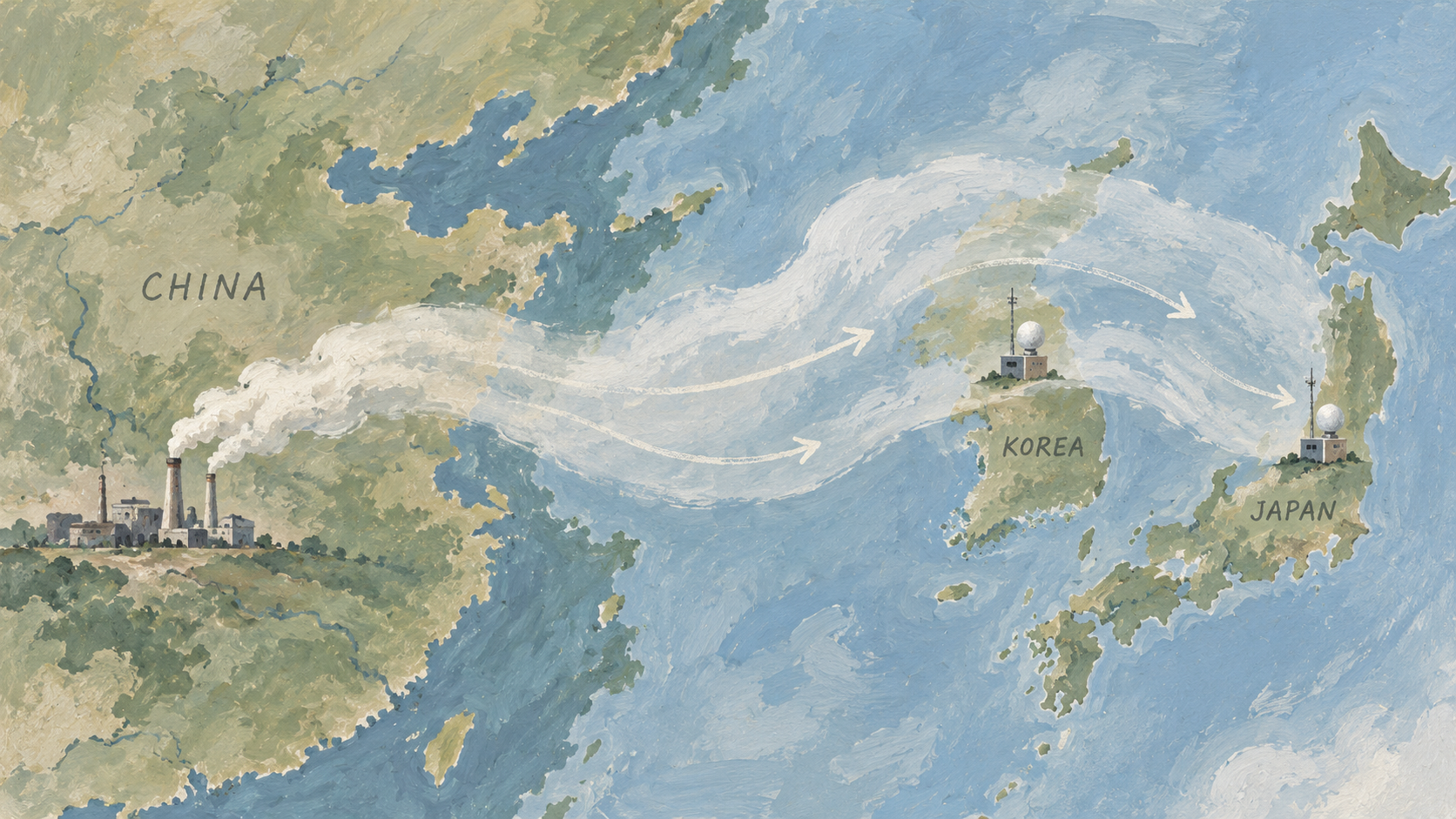
Air reaching an instrument has travelled over land and sea, mixed with other air, and collected emissions along the way. A high reading at a station doesn't mean the gas was released beside it. The wind can carry evidence across national borders.
Two stations were particularly useful: Gosan, on South Korea's Jeju Island, and Hateruma, in Japan. Both could receive air that had passed over industrial regions of East Asia.
A team including Matt Rigby and Sunyoung Park combined those measurements with atmospheric transport models. Their results appeared in May 2019. The regional investigation
Following the air backwards
The calculation begins with a question that runs forwards: if a region released a given amount of CFC-11, how much would reach a particular station, at a particular time?
Weather determines the answer. On one day, air reaching Gosan may have spent time over one industrial region. On another, it may have come from the ocean. The same factory emissions would therefore produce different readings on those days.
A transport model estimates how strongly each possible source region could contribute to each observation. Add the contributions together and you get a predicted concentration at the instrument.
The researchers needed the reverse: a pattern of regional emissions that could account for the measurements they actually had.
A single elevated reading would leave many possibilities open. A long sequence of readings, under changing winds and at different stations, makes the problem more constrained. A proposed source has to explain when the extra gas arrives, when it doesn't, and how large the increases are. Moving the source to another region changes those predictions.
This is an inverse problem. The observations are the effects; the calculation seeks the sources that produced them. The study used several modelling approaches to test how much the result depended on the particular method. The researchers' methods and manuscript
The evidence pointed to eastern mainland China, especially Shandong and Hebei. The team estimated that emissions there in 2014–17 were about 7,000 tonnes a year higher than in 2008–12. That accounted for a substantial fraction of the global increase.
The instruments could narrow down a region. Identifying businesses required people on the ground.
During 2018, in a separate investigation, the Environmental Investigation Agency contacted companies in China's foam industry. Its investigators reported widespread use of CFC-11 as a foam-blowing agent: the chemical helps create the bubbles in insulation foam. Companies described the practical and commercial reasons they were still using it. The report appeared that July, before the regional atmospheric study was published. The EIA's investigation
The two investigations approached the problem from opposite directions. One began with measurements of the air. The other began with the people making and buying foam.
Later measurements showed a sharp decline in emissions from eastern China. By 2019, the estimated regional emissions had returned to levels similar to those before the unexpected rise. The 2021 follow-up study
Some of the newly manufactured chemical had already been trapped inside buildings and products, adding to the stock that could leak in future years. Stopping production couldn't retrieve it. But its journey had supplied the evidence: gas released into the air had travelled far enough to reach instruments abroad, carrying a chemical record of an industry that wasn't supposed to be using it.