We’ve all written it hundreds of times: x. The unknown; The variable. But x and y didn’t come from nowhere; their history can be traced back to over a millennia ago. But, they might not stem from where you think. Everyone knows European mathematicians such as Pythagoras and Newton, but the vast majority of us have no clue where algebra comes from. In fact, it originates from an entirely different region: The Middle East. We’re Adam and Aidan, and this is the Common Denominator.
  While many of us correlate mathematics with European achievements, the forefront of mathematical advancement was spearheaded by countries in the Middle East and Asia. Notably, Brahmagupta from India invented the concept of zero, zu chongzhi was one of the first to precisely approximate Pi down to 7 digits (a record which was not broken for over 900 years). Muhammad ibn Musa al-Khwarizmi is credited as being the father of Algebra. You probably have zero clue who this is, and you wouldn’t be alone. The work of these historical figures has historically been undercredited.

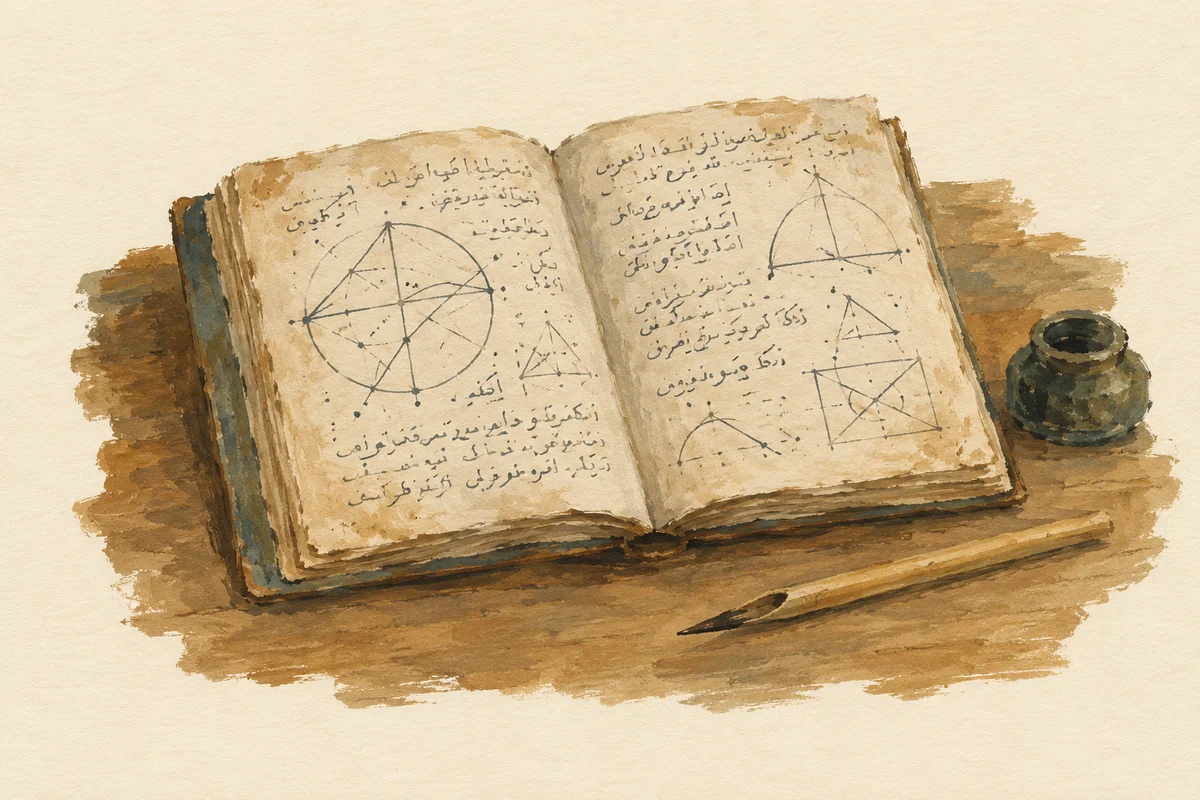
  In the 9th century, science and technology flourished in the Middle East under what is known as the Golden Age of Islam. Scholars from across the Middle East gathered in the Baghdad House of Wisdom: a library, research hub, and center for translation of texts. Texts from the most technologically influential regions of the world such as Greece, India, and all throughout the Middle East were preserved and built upon here. Muhammad ibn Musa al-Khwarizmi didn’t just add onto existing knowledge, he fundamentally reinvented the way mathematics operated. In his book, The Compendious Book on Calculation by Completion and Balancing (also known as al-Jabr), he laid the foundation for modern algebra. The word algebra itself directly comes from the Arabic word “al-Jabr” in the title of the book!

  What made his work so revolutionary was that it established an orderly and technical methodology to solving unknown elements in problems. This marked a shift from memorization and trial and error to a system that could be applied to any problem. This stretched from accounting to construction, making his work indispensable for practical matters throughout the world.
Completing the square
  During this time, Europe was severely lagging behind Islamic world in terms of science and technology. While Middle Eastern cities thrived as centers for learning, knowledge in Europe was heavily fragmented; information was preserved in monasteries and education was reserved for the nobility and upper class. In fact, the Catholic church actually tried to limit literacy as it threatened the clergy.

  Then came the crusades. While they are mainly remembered for their military and religious conflict, the crusades also opened up cultural contact between Europe and the rest of Eurasia. Europeans encountered science and technology centuries ahead of their own. By the 12th century European scholars had begun to seek scientific texts from the middle east and had begun to translate them into latin. The city of Toledo in Spain became the epicenter of this effort. After it was taken back from Muslim rule, it was left with a vast amount of knowledge from Arabic scholars that were previously unknown to Europe. Teams of translators scoured these texts and spent decades bringing them into the European intellectual world.

  It was here that “al-jabr” was introduced to Europe. However, while Al-Khwarizmi’s ideas flourished, his name did not. By the time Algebra had been formally integrated into European education, the origins of the system had largely been forgotten. Students learned the methods, but not the man behind them. Meanwhile, European figures like Newton became household names. The irony is that without al-Khwarizmi’s efforts, much of their work would have been impossible to achieve.

  Although his name faded, his importance did not. Algebra isn’t just something you’re forced to learn in high school that has no importance, it’s the backbone of the world as we know it. Every time you manage your time or split a bill, algebra plays a role. Engineers rely on it to build the bridges we cross and the buildings we live in. Math isn’t just abstract symbols on a piece of paper. When we uncover the true origins of math, we see that it’s not an achievement of culture or location, but a global achievement; an ongoing effort that’s built upon the contributions of scholars throughout the globe and over multiple millenia.