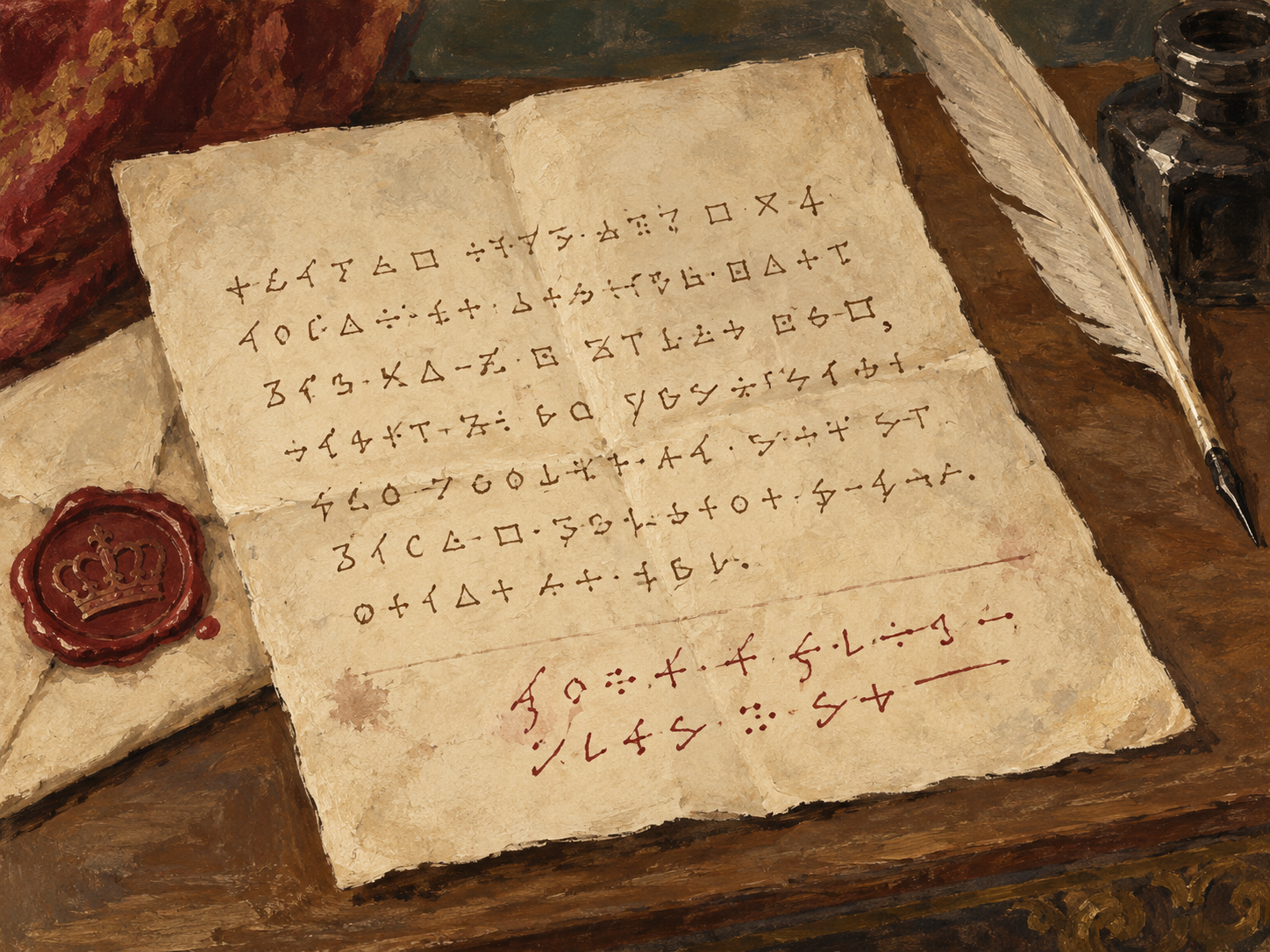
On 17 July 1586, Mary, Queen of Scots, dictated a letter from captivity at Chartley Hall. It was meant for Anthony Babington, a Catholic conspirator planning to free her and remove Elizabeth I from the throne.
The letter travelled in cipher. Before Babington read it, Elizabeth's intelligence operation did.
Thomas Phelippes, the man who deciphered it, drew a gallows on its address leaf. The message gave Mary's enemies evidence they believed could send her to her death. They also saw an opportunity to use her correspondence to identify more conspirators. The surviving letter and its history
They added a postscript.
Reading an encrypted message
The route was already compromised
Mary's correspondence had become difficult under close confinement. A clandestine route, using letters concealed in beer barrels, offered a way to communicate beyond her guards.
Francis Walsingham's agents controlled that route. Letters could be intercepted, opened, copied, deciphered, resealed, and delivered. A message reaching its destination therefore gave its sender no assurance that it had travelled unread. Continuing delivery helped preserve the channel's usefulness to the people watching it. The NSA's historical account of the operation
The conspirators still had their cipher. Its symbols concealed ordinary letters, with additional signs representing words or names and others inserted to complicate analysis. Such systems were known as nomenclators. They offered more protection than replacing each letter with a single unfamiliar symbol, though much of the underlying language could still leave patterns. An explanation of the cipher in The Code Book
Consider what a fixed substitution does to repeated letters. If the same letter always becomes the same symbol, two occurrences remain two occurrences. A double letter can become a double symbol. A common letter remains common among the enciphered letter signs.
The reader loses the familiar alphabet but retains relationships between parts of the message. That gives a cryptanalyst something to count and compare. A tentative reading of one symbol can produce a possible word; that word suggests other substitutions; those substitutions have to make sense elsewhere.
Whole-word signs and meaningless insertions make the work harder. They interrupt the straightforward relationship between letter counts and symbol counts. A successful solution has to explain enough of those complications to produce consistent readings across the correspondence.
Phelippes could read the intercepted messages. That created a further possibility: he could compose words in the same system.
Reading became impersonation
The legitimate recipient needed a rule for converting the symbols back into language. Once an interceptor recovered that rule, he could also use it in the other direction, converting his own language into symbols.
Babington could receive a perfectly readable passage in the expected cipher without Mary ever having dictated it. The familiar symbols wouldn't reveal whose hand had composed the passage. And because the intercepted letter continued along its established route, the altered message could arrive with the physical appearance of ordinary correspondence.
The added postscript asked for the identities of the men intended to carry out the assassination. Its purpose was to make Babington supply information in response to what appeared to be a request from Mary. The intelligence operation had moved from observing an exchange to participating in it. Archival research on Walsingham's operation
It is an effective trap on paper. The surviving correspondence shows how uncertain its operators felt in practice.
On 3 August, Walsingham wrote to Phelippes, worried that the addition had aroused Babington's suspicion. He had heard nothing further. The forged passage may have made the letter less convincing precisely because it asked for information the government wanted so badly.
Babington was eventually captured. His conspiracy collapsed, and Mary's correspondence became central to the case against her. She was executed at Fotheringhay in February 1587. The National Library of Scotland preserves her final letter.
The government already had incriminating correspondence before it added the postscript. The addition sought to draw out more evidence, with a risk its authors couldn't calculate from the cipher alone.
What survives is more revealing: Phelippes could read the cipher and write it, while Walsingham still worried that his target might recognise a false request. They had recovered the rules governing the symbols. Making another person believe the words remained a separate problem.