Traffic jams are an overlooked part of our lives that no one really thinks too hard about. Yet, they still impact us everyday. While they might make you mad, have you ever wondered how traffic jams actually form? Well, we did. We’re Adam & Aidan, and this is the Common Denominator.
 To really understand how traffic jams form, we first need to understand queuing theory. What's queueing theory, you may ask. Well, to make the long story short, queuing theory is how information is moved from one place to another in a closed system. Many people who research queuing theory try to optimize the transfer of information, taking into account different factors such as time taken, different ways to get from one place to another, and more. The optimized product is usually a grid, with different lines and curves connecting central points, known as nodes, to other nodes. Just as information moves from one node to another using connections, vehicles can move from one block or intersection to another on roads or streets.

 So, how do traffic jams form? Mathematically, it all comes down to the net flow, the amount of things entering a system vs the amount of things leaving a system. Imagine a highway as a moving queue. If cars leave at a faster rate than new ones come in, the net flow is positive; which means that there isn’t a traffic jam. But, the second the number of cars entering the system is equal to or greater than the number of cars leaving the system, any small problem anywhere in the chain can cause a ripple effect, impacting cars so far away that it seems almost impossible.

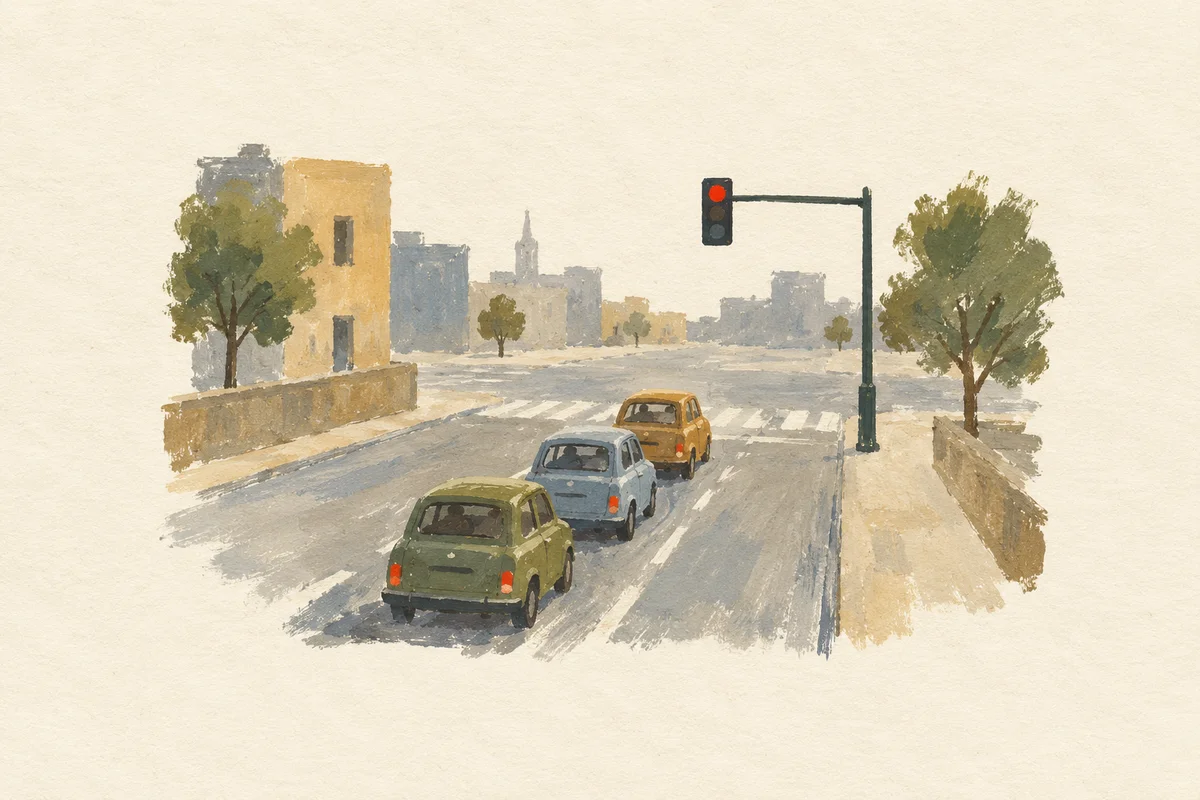
 Imagine this: A series of 5 cars are waiting at a red light. When the light turns green, it takes the first car 2 seconds to react and start moving forwards. The 2nd car takes another 2 seconds after the first car starts moving to react and move. This pattern continues down the line, until the last car has waited for 10 seconds. This doesn’t sound so bad, does it? However, we’ve forgotten to take into account that lights don’t stay green forever, so by the time the 15th car makes it to the light, chances are it's red again, during which many more cars join the queue.
Traffic flow
Blue: moving · gold: slowing · red: braking
 So how do we stop traffic jams? One solution might be to build more roads, but this is not the case. In fact, it's the exact opposite. This is called Braess’s paradox, which states that adding additional connections between nodes of a system may actually slow it down by changing the way agents in the system behave. If adding more roads doesn’t work, what does? Well, different cities use different strategies to combat this. Major cities like New York, London, Paris, and Tokyo all have highly developed subway systems, diverting a lot of traffic off of the roads and underground, where these problems are a lot easier to control. Other cities, such as Singapore, use an adaptive traffic light system, which changes the waiting time based on the number of cars queuing. Despite this, every system has problems. Queuing theory is about tradeoffs, not perfection; it can help us balance the goals of the system, but it cannot give us a solution.

 Unfortunately as the world grows bigger, traffic jams will only become more and more prominent. Yet, there is still hope. With the advancement of self-driving cars, we could minimize the human error in driving, lowering the chances of a traffic jam. In a perfectly functioning system, cars would drive as efficiently as possible, eliminating traffic jams completely. This also applies to other information systems, such as neural networks and even your brain. So the next time you're stuck in a traffic jam honking at the car in front of you to move faster, remember how mathematics caused you to be late, not the “bad driver” in front of you.